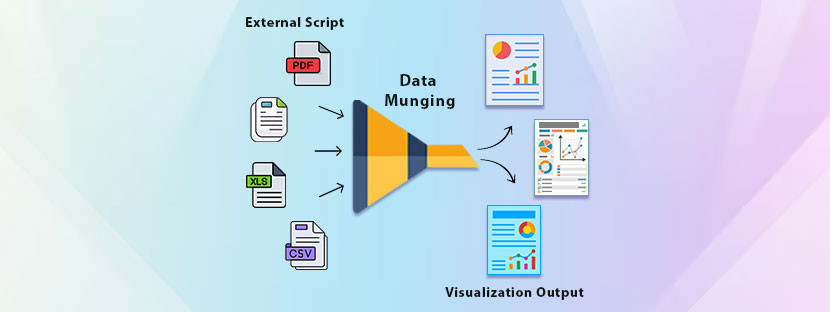
Most organizations have multiple and disparate data sources to welcome incoming data. This data comes in raw format. People who collect this kind of data often store it in an “as-is” format, with no change or revision.
Is this data ready for further assessments?
No. That’s where data munging comes into play. Data wrangling or data munging is a process where you convert your raw data into a more usable format.
Basically, using data mungling, you can create clean and structured data that is suitable for data analytics. This process will transform the unstructured, unorganized, and unpolished data into usable data formats. Data munging is a critical step that comes before you send your data to analytics.
Data Munging: Concept Explainer
A gap exists between raw data and actionable insights. You cannot put raw data into the analytics. To extract insights from your data in a standard way, you need to consider a process in between. Data munging is the process that fills this gap. The following tasks it does:
✔ Remove duplicate entries
✔ Find & replace missing values
✔ Reformat fields
✔ Merge data from other fields

Raw data is not an accurate form of data that you can allow AI models to learn from. You at least need some standardized data that you can trust. Data munging helps at that time.
Let’s now assess what else data munging can help ensure a smooth flow of data into your system.
Importance of data munging
First of all, data munging ensures your data is accurate and complete. It makes your raw data structured and polished. You can get a lot of critical benefits once you place data munging to close the gap between raw data and data insights.
➲ Make informed decisions: It becomes highly important to send structured data for processing. Otherwise, it can develop wrong data insights. Data munging minimizes the risks of misleading insights. It lays a solid ground for building data trust. So you can make informed decisions based on the available data that you have.
➲ Enhance data quality: Having no errors in data reflects better quality. Through data munging, you can remove errors and duplicate records from your database. Ultimately, you can end up having standardized data with you, which will be uniform in nature. Deploying quality data minimizes errors.
➲ Better data integration: Data coming from various sources may have errors. Data munging can save your data from being wasted. It minimizes inconsistencies and pushes data for better integration. Extract better insights through the integration of various types of data.
➲ Faster analysis: As you know, munging removes the unimportant parts of the data, and thus it makes the data easier to process faster. After removing the critical errors, it makes it easy to push through the analysis without any trace of critical spots.
➲ Cost-efficient: Data analytics is a costly process, and you cannot reverse the results once they’re done. Rather, you can spend some resources on munging can make a difference. Fixing data issues at the early stages saves time and resources later.

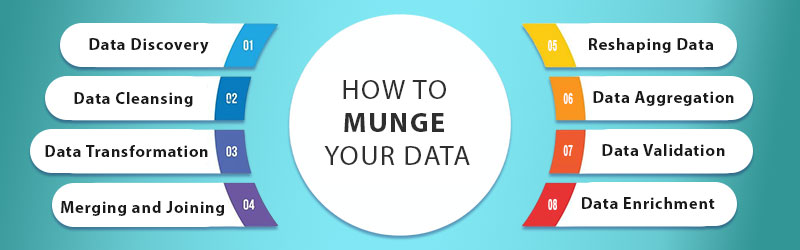
How to munge your data
Data goes through many stages before reaching the final stage of analytics. You cannot put raw data into analytics. At least you need to send organized data that is correct and presented in a well-formatted manner. Data munging is like the early stage, where you normalize datasets to bring transparency.
If you know how to refine data, you’d realize how data munging works. Let’s detail the processes of this mechanism.
Data discovery
Like its name, data discovery is a process to discover what characteristics, patterns, and anomalies the data contains. Also, it is the first step of data analysis. Various sub-processes, including outlier identification, finding missing values, and inconsistencies etc., take place. Defining the relationships between various variables also happens in this stage.
Data cleansing
📢 Is there any point where you need to put unhygienic data into your database?
👉 Of course not. Data cleansing is the process where you keep removing inaccurate, corrupted, duplicate, and poor-quality data from your database. If the data remains inaccurate, the insights will also be distorted. Therefore, it’s your responsibility to put clean data into your system. Data munging can help you establish a consistent data cleansing template to clean up your data routinely.
Data transformation
Raw data is mostly available in an unstructured format. And, unstructured data is difficult to analyze, model, or report. All you need to make the structure and format uniform before you begin the analysis. Data transformation can help you do so. This process makes sure your data format is suitable for analysis and modelling. It reduces the dimensionality of your data and transforms it into a standard range of values.
Merging and joining
Some parts of your data should go down, while some parts of the data need more enrichment. Merging different sources helps gather different sorts of data together. You can observe the shared relations between various datasets.
Creation of a unified database helps data users navigate through the data assets.
Reshaping data
Transforming data from the raw stage to the final polished stage is a part of data reshaping. Some important tasks like pivoting, melting, transporting, etc., are part of the data reshaping process. Data munging as a process involves all these processes.
✒️ Reshaping data plays a major part in data preparation, especially if it comes to survey data.
To extract meaningful insights from the data, you need to improve compatibility using analytical tools and procedures.
Data aggregation
Data validation
Using valid data should be your priority at all points in time. Data munging adds some data validation rules to all databases. It makes sure all your data gets validated on time without any loopholes. Validating data through multiple layers helps fix all inconsistencies across your data columns. It’s an important step to fix up all date formats and inconsistent units.
Data enrichment
Only put valuable data into your data processing units. Data enrichment is the process where you can make raw data reliable and accurate. This is also a process of appending data. Through this, you can add additional input to your existing data. Appending adds values to your existing datasets and provides more relevance and context to your data. Adding external sources to your existing data makes insights more actionable. Data munging can do all these things for you.